September Neighborhood Reports: The Fall Touch That Generates Listings
Sep 21, 2026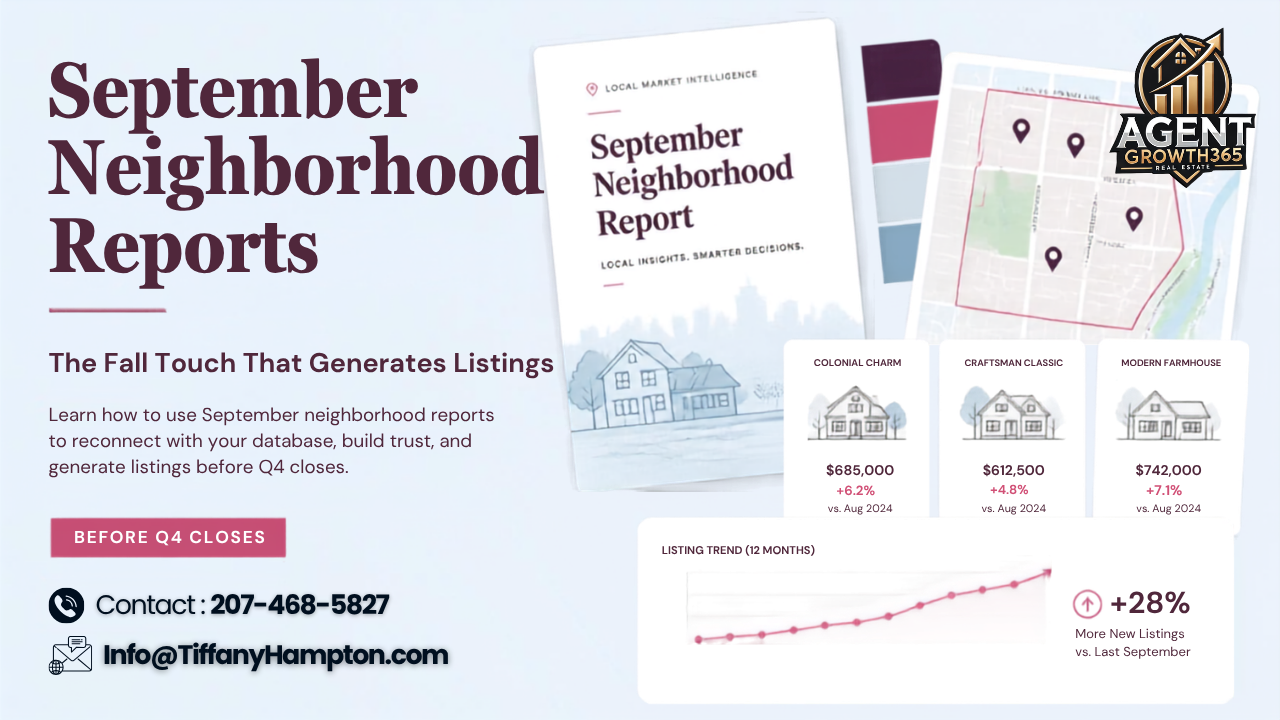
You worked hard this summer. You chased leads, followed up, stayed busy. But your pipeline
still feels thin, and Q4 is staring you down. You know you need listings, not just buyers. You
know your database has the answer somewhere inside it. But you are not sure what to send,
and you do not want to come across like every other agent dropping a generic newsletter into
someone's inbox.
Here is the truth: most agents skip the fall touch entirely. They tell themselves they will get
to it. They wait until November. By then, the window is gone and so are the listings that
could have closed before year end. The agents who close Q4 strong are not smarter. They are
earlier. They show up in September when the market shifts, the school year starts, and
homeowners begin asking questions they were not asking in July.
A September neighborhood report is not a mass marketing piece. Done right, it is a
conversation starter. It is the reason you pick up the phone, send a handwritten note card, or
knock on a door. It gives you something specific to say that serves the person receiving it.
That is how a touch turns into a listing appointment.
Why September Creates a Natural Opening
The fall market moves differently than summer. Buyers who missed out in the spring are
making one more push before year end. Families who moved for school have just settled in
and their former neighbors are wondering how much their street is worth now. Homeowners
who have been thinking about downsizing or relocating spent the summer watching their
neighborhood change. September brings a shift in attention that works in your favor if you
are paying attention.
Coaching data shows that agents who send market-specific information tied to a
neighborhood see higher response rates than agents sending general market updates. The
reason is simple. A homeowner in a specific subdivision cares about what is happening on
their street. They do not care about the county average. When your report names their
neighborhood, their street, or their zip code, they read it. When it matches a question they
already have, they respond.
This is also when past clients start thinking about their next move. The new school year
creates a hard reset for a lot of families. Coaching data from fall campaigns consistently
shows that September and October produce more inbound seller inquiries than August does,
even though more agents go quiet after Labor Day.
What Goes Into a Neighborhood Report That Actually Works
Do not overthink this. A neighborhood report is not a custom property analysis. It is a clear,
short summary of what happened in one neighborhood over the last 60 to 90 days. Keep it
focused. Keep it readable. Keep it specific.
Here is what to include:
● How many homes sold in the neighborhood in the last 60 to 90 days
● The average days on market for those homes
● The average sale price and whether it went up or down compared to spring
● How many homes are currently active or under contract
● One honest line about what this means for a homeowner thinking about selling this
fall
That last line is what separates a useful report from a data dump. A homeowner reading your
report does not know what the numbers mean for them. Your job is to tell them. "With only
two active listings in your neighborhood right now, a well-priced home has very little
competition heading into October" is a sentence that answers the question they are already
asking.
If you track the 100 conversations per week framework, this report becomes your
conversation anchor for the week. You are not calling to check in. You are calling to share
something specific and useful. That changes the entire tone of the call.
How to Distribute It Without Losing the Personal Touch
Here is where most agents drop the ball. They create the report, they email it to their list, and
they wait. Nothing happens. The email sits unopened or gets skimmed and deleted. They
conclude that neighborhood reports do not work. What did not work was the distribution,
not the strategy.
The report is the tool. The touch is the work.
For your top 25 to 50 relationships in that neighborhood or sphere, pair the report with a
handwritten note card. Coaching data consistently shows handwritten notes get opened and
read at far higher rates than email. A short note that says something like "Pulled the
numbers for your neighborhood this month, thought you would want to see what is
happening. Call me if you have questions" takes two minutes to write and creates a physical
object that sits on a kitchen counter. Emails do not sit on kitchen counters.
For the broader database, an email is fine. But follow up the email with a phone call within
48 hours to the people who matter most. Use the report as your reason to call. "Hey, I sent
over the neighborhood numbers for your area. Did you get a chance to see them?" That
question opens a real conversation far more reliably than "just checking in."
If you door-knock, this is one of the cleanest reasons to show up. "I put together a report for
your neighborhood and wanted to drop it off personally." That line gets you inside
conversations that a mailer never will.
The 3-Appointment Rule and How This Fits
If you work the 3-Appointment Rule starting your daily lead generation at 9 AM, your
September neighborhood report becomes a specific call purpose for the first two hours of
your day. You are not making vague follow-up calls. You are calling with a reason, a tool, and
a service to offer. That makes the call easier to make and easier to receive.
Build your call list around the report. Identify which neighborhoods you want to generate
listings from in Q4. Pull your database for everyone who owns in those neighborhoods or has
a referral connection there. Work that list every morning for two weeks. The report is the
opener. The appointment is the goal.
Coaching data from agents who use this approach in September shows that the number of
seller consultations booked in October goes up significantly compared to agents who go quiet
after summer. The work you do in the next three weeks is what fills your pipeline before
Thanksgiving.
Connecting the Report to the Golden Letter Strategy
If you work with buyers who are looking in specific neighborhoods, your neighborhood
report becomes the trigger for your golden letter strategy. When a buyer is searching a
neighborhood and inventory is thin, a letter to homeowners in that neighborhood serves two
purposes: it may generate the off-market opportunity your buyer needs, and it positions you
as the agent who knows that neighborhood deeply.
Your report gives you the credibility to send that letter. You are not sending a cold
solicitation. You are a neighborhood specialist who tracks the data and can tell that
homeowner exactly what their home could sell for right now based on real, current numbers.
This combination of the neighborhood report and a targeted letter can produce listing
appointments that never hit your competition's radar.
What Not to Do
Do not send the same report to every neighborhood and change only the name at the top.
Homeowners can tell when something is templated. Use actual data for the actual
neighborhood. If you do not have the time to pull data for ten neighborhoods, pull it for
three. Three real reports distributed with intentional follow-up will outperform ten generic
ones every time.
Do not lead with your brand. Lead with their information. The homeowner does not care
about your logo. They care about their equity. Make the first sentence of every report about
them and their neighborhood, not about you.
Do not skip the follow-up. The report without the follow-up is marketing. The report plus the
follow-up is lead generation. Your income comes from the second half.
Bottom Line
September is not a slow month. It is the setup month for your Q4. The agents who generate
listings before November are the ones who show up in September with something worth
showing up with. A neighborhood report done with real data and distributed with personal
touches is one of the most reliable tools you have right now. It gives you a reason to call. It
positions you as a local expert. It starts conversations that turn into appointments. Your
database already knows people who are thinking about moving. Your job is to give them a
reason to tell you that.
Consistency beats intensity. One neighborhood report sent with discipline and followed up
by phone calls and handwritten notes this week is worth more than a big marketing push in
November. Start now. The window is open.
Your Homework
Pick one neighborhood where you want to generate a listing before December 31.
Pull the last 60 to 90 days of sales data for that neighborhood this week.
Write a one-page report using the five elements outlined above.
Identify 25 people in your database connected to that neighborhood, whether they live there,
have referred someone there, or have expressed interest in the area.
Send a handwritten note card to each of them with the report attached or a short teaser that
directs them to call you.
Follow up by phone within 48 hours of the note dropping.
Book at least one seller consultation from that list before October 15.
That is one neighborhood, one report, one focused two-week push. If you repeat that process
for two or three neighborhoods, you will have a full Q4 pipeline before the leaves are on the
ground.
If you want a framework for building your fall outreach calendar around your database, start
a conversation at AgentGrowth365.com. The goal is to help you work with a system, not just
a schedule.
Tiffany Hampton is a seasoned real estate leader and MAPS Coach with 28 plus years of experience and over 1,000 transactions, helping agents succeed through leadership, coaching, and innovative strategy. As the founder of AgentGrowth365.com, Tiffany delivers proven systems, tools, and training that empower agents and market center leaders to grow with clarity and purpose. Whether you’re looking to hit 24 transactions, streamline your coaching systems, or lead your business with impact, AgentGrowth365 offers a full suite of solutions designed to meet today's challenges and scale tomorrow's success.
Stay connected with news and updates!
Join our mailing list to receive the latest news and updates from our team.
Don't worry, your information will not be shared.
We hate SPAM. We will never sell your information, for any reason.
