The Fall Sphere Event: A Touchpoint That Builds Spring Listings
Oct 28, 2026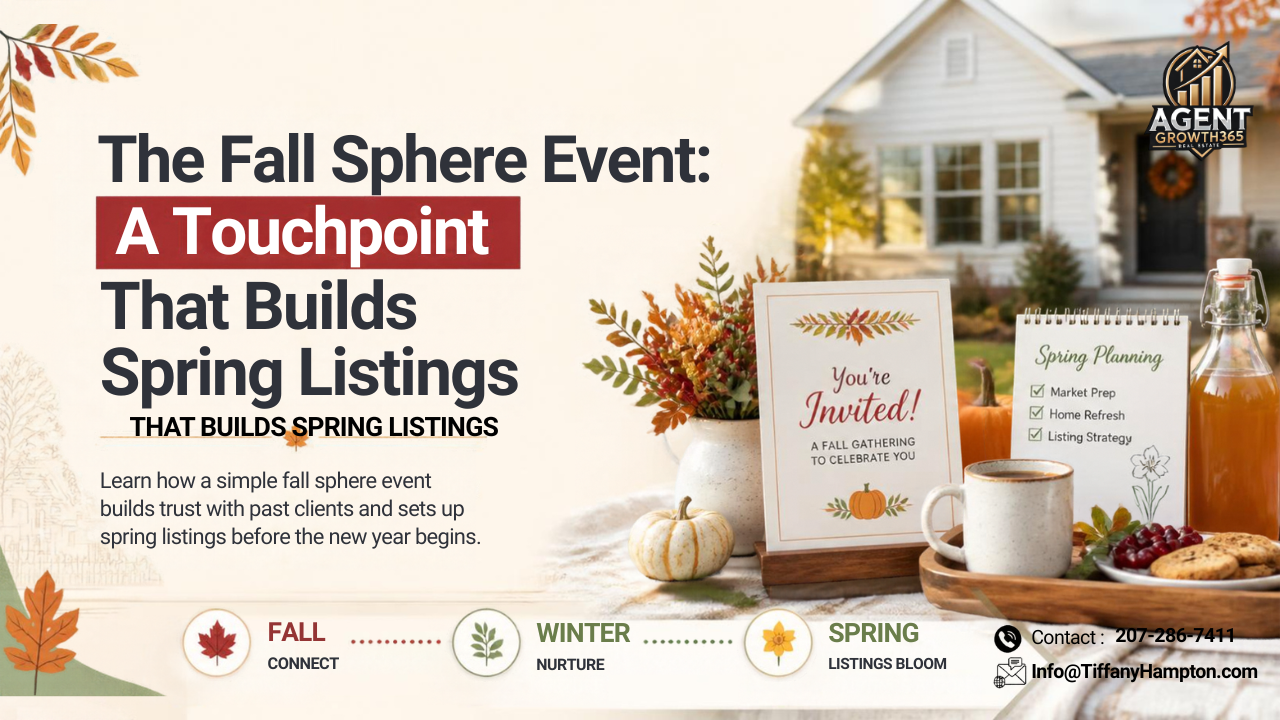
You work hard all year. You close deals in October, hit your numbers, and then watch the
pipeline go quiet. January feels like starting over. You wonder why referrals are not more
consistent, why your past clients call someone else, and why every spring feels like a
scramble.
The answer is almost never your skill. It is your presence. If your sphere does not hear from
you between August and February, they forget you are in the business. Not because they do
not like you. Because life is loud and agents are everywhere.
One intentional event this fall changes that. It does not cost a fortune. It does not require a
big team or a polished venue. It requires you to show up for the people who already trust
you, before someone else gets there first.
This is how agents build spring listings from fall relationship work.
Why Fall Is the Right Window
Most agents slow down in October. Deals are closing, kids are back in school, and the market
has shifted from the summer sprint. That slowdown is the exact reason this works.
Your sphere slows down too. They have more time to receive you. A fall touchpoint lands
when people are thinking about the year ahead, about what they want to change, and about
who they want to do business with. That mental space is where your event plants a seed.
Coaching data shows that agents who run a meaningful sphere event in October or
November consistently see an increase in inbound referral conversations in January and
February. The event itself is not magic. The consistency of contact is what does the work. A
fall event is one of the highest-leverage touchpoints in the entire year because it bridges the
holiday gap and keeps you in front of your people when most agents disappear.
What a Fall Sphere Event Actually Looks Like
You do not need a catered dinner or a rented event space. You need a reason to gather and a
format that feels personal, not promotional.
Here are three formats that work at different budget and bandwidth levels.
The backyard or home gathering. You host 20 to 40 people at your home or a casual outdoor
space. Pumpkins, cider, food, kids welcome. The tone is warm and neighborly. You are not
presenting anything. You are present. The value is the experience and the memory.
The community event partnership. You partner with a local business, a pumpkin patch, a fall
market, or a restaurant, and you host a section of their event. You sponsor drinks, desserts,
or a kids' activity. Lower cost, built-in foot traffic, and your name on the experience.
The small group coffee or lunch series. Instead of one large event, you run four or five
gatherings of eight to twelve people each over three weeks. These feel more intimate and give
you real conversation time with each person. Coaching data supports this format for agents
who want deeper relationship repair with a database they have not stayed in front of.
Pick one format that fits your life right now. The best event is the one you will actually
execute.
Who Goes on the List
Your event list is not your entire database. It is your A and B tier contacts. These are the
people who have closed with you, referred someone to you, or told you they were planning a
move in the next one to three years.
Pull that list now. If you do not have it sorted, this is the week to do that work. Go through
your contact database, label your top tier, and build the invite list from that group. Shoot for
40 to 80 people depending on the format you choose.
Here is the piece agents miss. The invite itself is a touchpoint. A handwritten note card
mailed to each person with a short, personal invitation outperforms a group email by a wide
margin. Coaching data on handwritten notes consistently shows response rates that email
cannot match. The note does not need to be long. It needs to feel like it came from a person,
not a campaign.
Write the note in your own words. Mention something personal when you can. Three
sentences is enough.
How to Connect at the Event Without Pitching
The single biggest mistake agents make at sphere events is making it about real estate. You
do not need to talk about the market, your listings, or your production numbers. Your guests
already know what you do. They came because they like you. Your job is to deepen that
relationship, not to close a deal.
Move through the room with intention. Spend three to five minutes with each person. Ask
what is new in their life. Ask what they are looking forward to in the next year. Listen more
than you talk.
When real estate comes up naturally, and it will, keep your answer short and curious. Ask
them what they are thinking. Do not pitch. Just open the door.
After the event, you will have a list of people who brought up real estate, mentioned a move,
or asked about the market. Those are your follow-up conversations for November and
December.
Turning the Event into Spring Pipeline
The event is not the end. It is the beginning of a conversation series that runs through the
holidays and into January.
Here is the sequence that works.
Week of the event. Send a short handwritten thank-you note to every person who attended.
Mention one specific thing from your conversation. This is the move most agents skip. It is
also the move that makes the biggest impression.
Two to three weeks after the event. Follow up personally with anyone who mentioned real
estate, a life change, or a possible move. A phone call is better than a text here. Keep it brief.
You are checking in, not pitching.
December. Send a holiday card to your full database. Not an email. A physical card. This is
your second touchpoint in six weeks for everyone on your list. You are building momentum.
First week of January. Call your top tier contacts. Not to prospect. To wish them a great year
and ask one simple question: "Is there anything I can help you think through this year,
whether it is real estate or something else in your network?" That question opens
conversations.
This sequence turns one fall event into four to five touchpoints over ten weeks. That is what
builds a spring pipeline. Not one big push. Consistent, warm, personal contact through the
months when most agents go quiet.
The Math Behind the Strategy
If you host a fall event and touch 60 people through this sequence, you will have meaningful
conversations with a meaningful percentage of them. Coaching data shows that agents who
stay in consistent contact with their sphere during Q4 carry more active buyer and seller
conversations into January than agents who pause outreach during the holidays.
You do not need all 60 people to be ready to move. You need five to ten people to think of
you first when the question comes up for them or someone they know. That is enough to shift
your first quarter.
The database is the business. You have already done the hard work of earning these
relationships. The event is how you protect and grow what you have already built.
A Word on Consistency Over Intensity
One event will not fix an inconsistent pipeline. But one event, followed by the sequence
above, followed by a January 1-to-1 call campaign, followed by consistent monthly contact
through spring, will. The pattern matters more than the peak moment.
If you are reading this and you have not stayed in front of your sphere this year, do not let
that stop you. You do not need to apologize for going quiet. You just need to show up now.
People respond to sincerity. An event in late October or early November still lands. There is
still time.
The agents who build predictable income are not the ones with the best scripts or the most
social media posts. They are the ones who show up for their people, over and over, in
personal and memorable ways.
Bottom Line
A fall sphere event is not a party. It is a business strategy. It keeps you in front of the people
most likely to hire you or refer you before the year ends. The follow-up sequence you run
after the event is what converts warm relationships into spring listings. Plan the event, write
the notes, make the calls, and let the consistency do the work.
Your Homework
This week, do these three things.
1. Pull your A and B tier contacts from your database and build your invite list. Aim for 40 to
80 people.
2. Choose one event format that fits your schedule and your bandwidth for the next three
weeks.
3. Write and mail your handwritten invitations before Friday. Every day you wait is a day
your guests have less time to plan to attend.
If you are not sure where to start with sorting your database or building the follow-up
sequence, that is exactly the kind of work a coaching conversation can move through quickly.
Visit AgentGrowth365.com to explore what current agents are working on and whether a
coaching conversation fits where you are right now.
Tiffany Hampton is a seasoned real estate leader and MAPS Coach with 28 plus years of experience and over 1,000 transactions, helping agents succeed through leadership, coaching, and innovative strategy. As the founder of AgentGrowth365.com, Tiffany delivers proven systems, tools, and training that empower agents and market center leaders to grow with clarity and purpose. Whether you’re looking to hit 24 transactions, streamline your coaching systems, or lead your business with impact, AgentGrowth365 offers a full suite of solutions designed to meet today's challenges and scale tomorrow's success.
Stay connected with news and updates!
Join our mailing list to receive the latest news and updates from our team.
Don't worry, your information will not be shared.
We hate SPAM. We will never sell your information, for any reason.
