The October Past Client Call: A Conversation That Books November Closings
Oct 07, 2026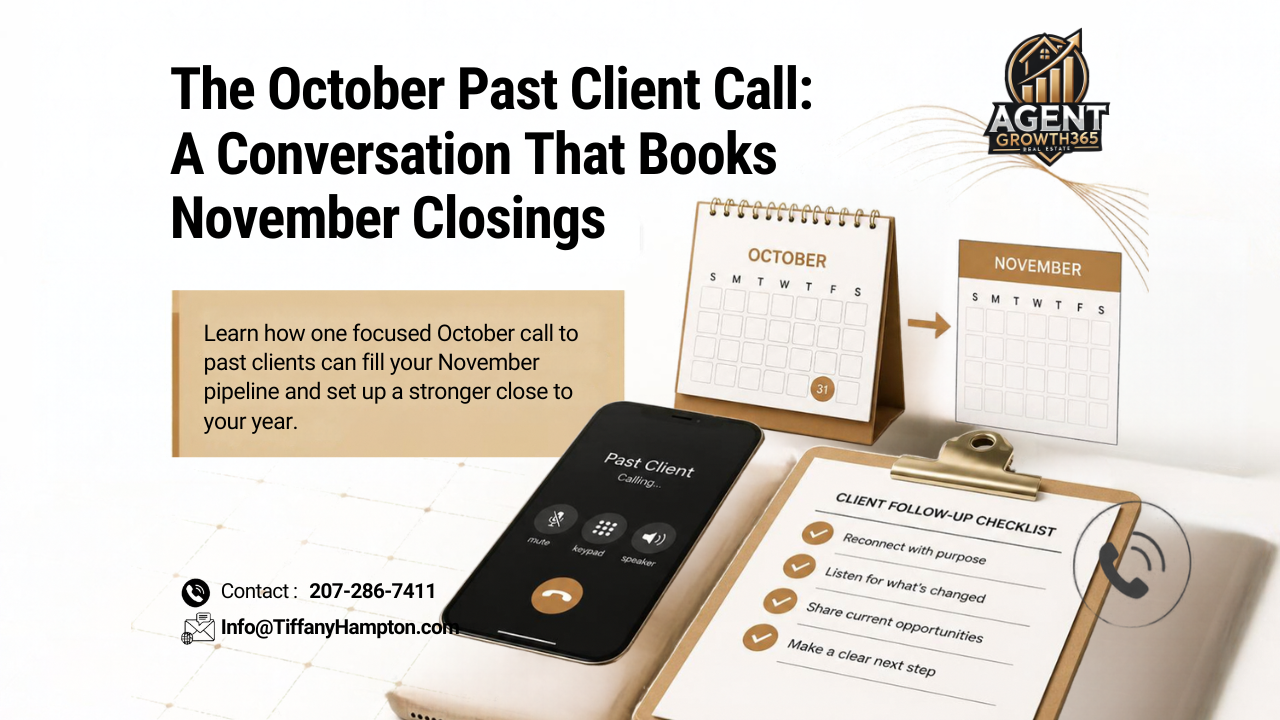
You are three months from the end of the year and your pipeline feels thin. You have worked
hard all summer. You showed homes, wrote contracts, put out fires, and somehow you are
still looking at a calendar with fewer closings than you planned. The leads you chased did not
convert. The referrals you expected did not show up. You are tired and a little frustrated, and
the holidays are coming fast.
Here is the hard truth: the closings you need in November are sitting in your database right
now. Not in a new lead source. Not in a paid ad campaign. In the names you already have. In
the clients who already know you, trust you, and would pick up the phone if you called.
The problem is that most agents do not make that call. They mean to. They tell themselves
they will get to it. Then October passes, the market slows, and they spend January wondering
why last year was so flat.
This post is about making that call, doing it well, and turning a ten-minute conversation into
a closing you can count on before the year ends.
Why October Is the Right Month for This
October sits at a useful spot in the year. The summer rush is over. The market has a different
rhythm. Buyers who missed out earlier are reconsidering. Sellers who wanted to wait until
spring are starting to ask whether they should move before the holidays or just get ahead of
the spring market now.
Your past clients are thinking about these things. They are talking to neighbors at fall
cookouts. They are watching what homes sold for on their street. They are calculating
whether they have enough equity to make a move. They are not calling you because they do
not know you are thinking about them.
One call from you changes that.
Coaching data shows that agents who contact their sphere in October with a specific, service-
oriented reason close more transactions in the final quarter than agents who wait for
inbound calls. The difference is not the market. The difference is who made the call.
What This Call Is Not
Before you pick up the phone, get clear on what this call is not.
It is not a pitch. You are not calling to announce that you are in the market for listings. You
are not leading with your production numbers or your team awards. You are not asking for a
referral in the first sixty seconds.
It is not a check-in with no purpose. The call that says "hey, just checking in" communicates
that you have nothing to offer. It wastes the client's time and it wastes yours.
It is not a script you read from. When a client hears you reading, they feel it. Real
conversations win. You need a framework, not a monologue.
What the Call Is
The October past client call has one purpose: find out where the client is right now and let
that tell you what they need next.
That purpose sounds simple. It requires real listening. Here is the structure that works.
The Opening
Start with something personal and specific to them. Not a generic opener. Something you
actually remember.
If you helped them buy a starter home two years ago, you know they were planning to grow
into a larger place. Say that. If they sold in the spring and told you they were renting while
they figured out where to land, ask about that.
You are calling because you have been thinking about them. Make that true before you dial.
A simple opening sounds like: "I was thinking about you this week. How is the house treating
you?" Or: "You mentioned at closing that you were thinking about a bigger place in a couple
of years. I wanted to see where you were with that."
You are not cold-calling a stranger. You are calling someone who shook your hand and
thanked you and meant it. Act like it.
The Middle
After the opener, ask one open question and then stop talking.
A question like: "Are you still planning to stay put for a while, or have you been thinking
about making a move?"
Then listen. Do not fill the silence. Let them answer. Let them go where they want to go.
What they say next will sort them into one of two buckets.
The first bucket is NOW business. They say something like: "Actually, we have been talking
about that. The kids are both in school now and we need more space." Or: "We were going to
wait but I got a new job offer and things might change." Those are signals. Note them. Book
an appointment before you hang up.
The second bucket is FUTURE business. They say: "We love the house. Not going anywhere
anytime soon." That is fine. You are not looking for an excuse to push. You are looking for
the truth. A client who tells you they are staying is giving you information you can use twelve
months from now when you call again.
Both answers help you. Neither answer is a failure.
The Close
Before you wrap up, do one more thing. Ask for the referral, but do it the right way.
Do not say: "Let me know if anyone you know needs an agent."
Say: "Is there anyone in your circle who has mentioned wanting to buy or sell before the
holidays? I have a few clients looking to move quickly and I always want to help people I
trust first."
That version is specific. It gives them a reason to think. It names a real situation. It is more
likely to produce an answer.
Then end the call on a genuine note. Thank them for their time. Tell them you will follow up
with the market update you promised. Send it that same day.
How to Build This Into October Without Letting It Slip
The call does not work if you make it once and forget it. You need a plan for the whole
month.
Here is a practical structure:
Week one: Pull the list. Go into your database and identify every past client from the last
three years. Flag the ones who bought or sold in the spring or summer, the ones who
mentioned a life event at closing, and the ones you have not spoken to since their transaction
closed.
Week two: Start calling. Set a daily goal. Ten calls per day is enough. Ten calls per day over
four weeks is roughly eighty to one hundred conversations. Coaching data shows that one
hundred intentional conversations with your sphere per week produces consistent pipeline.
In October, if you hit that number over the full month, you will find your November closings
in that list.
Week three: Follow up. Every call that ended with an appointment goes on your calendar
immediately. Every call that surfaced a referral gets a next step within forty-eight hours.
Every client who said "not yet" gets a handwritten note card. Not an email. A physical card
with your handwriting on it. The response rate from a handwritten note outperforms a
digital follow-up by a wide margin. That specific practice is one of the highest-return habits
in the system.
Week four: Review and reset. Look at what you found. Count the appointments you booked.
Count the referrals you gathered. Adjust your November pipeline math based on what you
know now, not on what you hoped in January.
One More Tool for the Right Client
If you have a past buyer who now has equity, October is also the right time to send a golden
letter. This is a specific, personalized note written to that client that speaks directly to their
equity position and the current market conditions. It is not a generic flier. It reads like a
letter from a person who has been paying attention to their neighborhood.
Agents who add the golden letter alongside the October call give clients two reasons to raise
their hand. Some clients will respond to the letter before you even reach them by phone.
Others will mention they got your note when you call. Either way, the combination creates
more surface area for the conversation to start.
What You Are Really Doing in October
You are not making calls. You are building a business that does not depend on luck or the
next algorithm change or a new lead source you cannot afford.
Your database is your business. The clients in it have already chosen you once. When you
stay in front of them with intention and genuine care, they choose you again. And they tell
other people.
Consistency in this work beats any campaign you can run. An agent who calls thirty past
clients a week every week in October will outperform an agent who sends one mass email
and waits. Every time.
Bottom Line
Your November closings are not coming from new leads. They are in conversations you have
not started yet. October gives you the time and the reason to start them. One focused call, a
genuine opening question, real listening, and a specific ask for referrals. That is the system.
Work it this month and your pipeline will look different by November first.
Your Homework
This week, pull your past client list and identify the ten names most likely to be thinking
about a move before the end of the year. Call each one using the framework above. Aim for a
ten-minute conversation. Book at least one appointment from that group before Friday. If a
call does not lead to an appointment, send a handwritten note card the same day. Track
every call, every appointment booked, and every referral named. At the end of the week, look
at your numbers and decide how many calls you will commit to in week two.
If you want to talk through your October call strategy or build out your pipeline math for the
fourth quarter, visit AgentGrowth365.com to explore coaching options. There is no pressure,
just a real conversation about where you are and where you want to go.
Tiffany Hampton is a seasoned real estate leader and MAPS Coach with 28 plus years of experience and over 1,000 transactions, helping agents succeed through leadership, coaching, and innovative strategy. As the founder of AgentGrowth365.com, Tiffany delivers proven systems, tools, and training that empower agents and market center leaders to grow with clarity and purpose. Whether you’re looking to hit 24 transactions, streamline your coaching systems, or lead your business with impact, AgentGrowth365 offers a full suite of solutions designed to meet today's challenges and scale tomorrow's success.
Stay connected with news and updates!
Join our mailing list to receive the latest news and updates from our team.
Don't worry, your information will not be shared.
We hate SPAM. We will never sell your information, for any reason.
